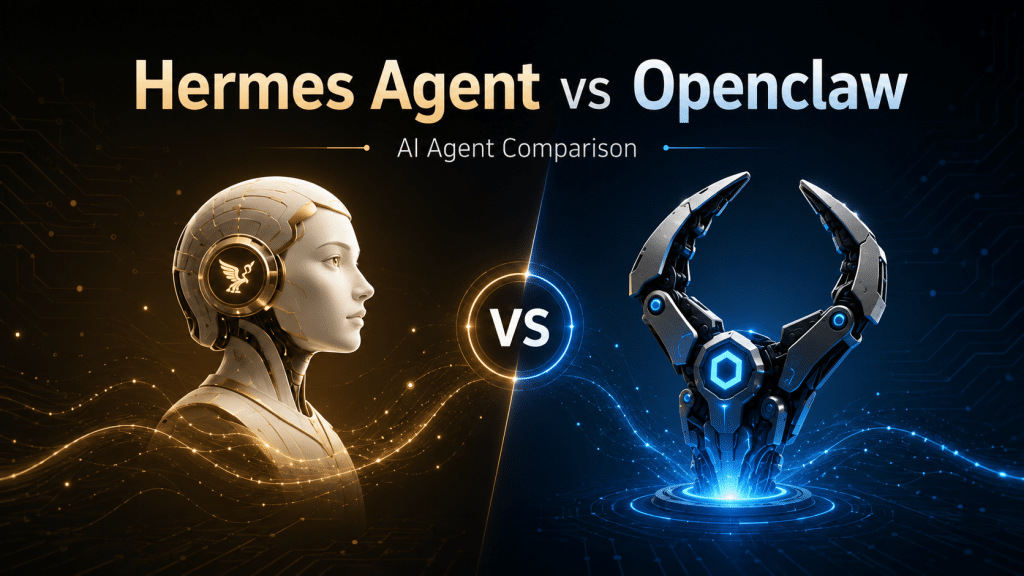
If you’ve spent any time in the open-source AI agent space in 2026, you’ve hit the same wall: OpenClaw or Hermes? Both are MIT-licensed, both are model-agnostic, and both have vocal communities that will swear theirs is the obvious choice. This comparison cuts through that noise.
What follows is a neutral, data-backed breakdown of hermes agent vs openclaw built on architecture documentation, published security audits, and over 1,300 Reddit comments across 25 high-engagement threads. No vendor affiliation. No product to sell.
The short answer: OpenClaw is the right choice when you need a control plane for multi-channel, multi-agent orchestration. Hermes is the right choice when you want an agent that learns and improves on its own. A growing number of experienced users run both.
TL;DR: Which Agent Wins for Your Use Case?
Before diving into the details, here’s a quick-reference summary of the core tradeoffs:
| Dimension | OpenClaw | Hermes Agent |
|---|---|---|
| Best for | Multi-channel orchestration, multi-agent teams | Repetitive automation, self-improving workflows |
| Setup time | Under 30 minutes (Docker Compose) | 2-4 hours (smoother defaults) |
| Core strength | 22+ platform integrations, 13,700+ community skills | Self-learning skill loop, checkpoint/rollback |
| Main weakness | Updates frequently break things; 6 documented CVEs | Self-evaluation unreliable; too few releases to prove stability |
Both frameworks are MIT-licensed and model-agnostic. You can run either with Claude, GPT, Qwen, Gemini, or a local model via Ollama or OpenRouter. The comparison in this article is based on architecture docs, security audits, and 1,300+ comments from real users.
What Are OpenClaw and Hermes Agent? (Origins and Philosophy)
These two tools share a surface-level similarity but diverge sharply in their design philosophy.
OpenClaw started as a personal project called Moltbot, built by Austrian developer Peter Steinberger. When Steinberger joined OpenAI on February 14, 2026, the project was transferred to an independent foundation and renamed OpenClaw. According to Star History and GitHub data, it now has 374,000+ GitHub stars, 77,800+ forks, and 2,300+ contributors. The framework is built around a persistent gateway daemon: a long-running process that routes messages across platforms, manages sessions, and dispatches skills. OpenClaw is a tool you configure. Once you’ve set it up, it stays the same until you change something.
Hermes Agent is the work of Nous Research, an open-source AI lab known for its Hermes model series. The repo was created on July 22, 2025, and developed internally for eight months before the first public release on March 12, 2026 (v0.2.0). Lead contributor teknium1 has 2,549 commits. PopAI Explorer data puts the project at 191,000+ GitHub stars, 33,000+ forks, and 300+ community contributors. Hermes is a runtime-first agent. Its central abstraction is a learning loop: the agent creates and refines its own skills from experience. Hermes is a teammate that gets better the longer you use it. In May 2026, Hermes hit #1 on OpenRouter’s global token rankings with 271 billion tokens processed across all AI apps on the platform.
The philosophical difference is the clearest way to understand everything else in this comparison: OpenClaw is infrastructure you control. Hermes is an agent that adapts.
That distinction matters more than people expect. According to SaaSUltra’s 2026 enterprise data, the global AI agent market is $10.91 billion and growing at 45.8% CAGR. But 79% of enterprises have adopted agents in some form while only 11% are running them in production. The choice of framework affects which side of that gap you land on.
| OpenClaw | Hermes Agent | |
|---|---|---|
| Origin | Moltbot (2025), renamed Feb 2026 | Nous Research, launched March 2026 |
| GitHub stars | 374,000+ | 191,000+ |
| License | MIT (plus commercial SaaS) | MIT (no commercial SaaS) |
| Core philosophy | Gateway-first | Runtime-first, learning-first |
| Built with | TypeScript / Node.js | Python 3.11 |
Architecture and Technical Foundations
The architectural difference between these frameworks isn’t a matter of style. It changes what they’re actually good at.
OpenClaw is built in TypeScript/Node.js. That’s the right language for I/O-heavy gateway work: concurrent channel connections, webhook handling, real-time message routing. The entire system runs through a typed WebSocket API (ws://127.0.0.1:18789). Incoming frames are validated against JSON schemas, and exactly one gateway daemon runs per host.
Hermes is built in Python 3.11. That integrates far more naturally with the ML ecosystem: vLLM, llama.cpp, RL training tools, and the broader Python data science stack. The primary entry point is the command line, not a daemon. The gateway mode is an optional extension added on top.
Multi-agent support:
OpenClaw supports persistent agent teams with cross-session state. Agents communicate with each other and hold shared context. Since v4.2, the Agent Communication Protocol (ACP) handles inter-agent messaging, thread-bound sessions, and sub-agent spawning.
Hermes uses a parent-subagent model. Isolated sub-agents spin up for parallel execution, complete their task, report back, and disappear. There’s no direct inter-subagent communication. It’s a cleaner model for isolated parallel work but a weaker one for complex persistent team dynamics.
Platform coverage:
OpenClaw natively binds 22+ platforms: Telegram, Discord, Slack, WhatsApp, iMessage, Signal, Matrix, Microsoft Teams, Google Chat, IRC, LINE, Nostr, Twitch, Zalo, and more. Hermes connects to 13+ platforms: Telegram, Discord, Slack, WhatsApp, Signal, SMS, Email, Mattermost, Matrix, DingTalk, Feishu, WeCom, and Home Assistant.
If breadth of platform coverage matters to your setup, OpenClaw wins by a clear margin.
Background execution:
OpenClaw is local-machine oriented with its persistent daemon. Hermes is better suited for cheap VPS deployment. Sub-agents are stateless by default, and memory lives on disk first, making it easier to run reliably on minimal infrastructure.
Memory and Persistence
How each framework handles memory is one of the most practically significant differences between them, and it’s an area where they’ve made fundamentally different tradeoffs.
OpenClaw’s file-based memory stores everything in MEMORY.md and daily journal files (formatted as YYYY-MM-DD.md). There’s no hard size limit. Files get indexed into SQLite and searched via FTS5 with optional vector embeddings. Three backends are available: Builtin (SQLite), QMD (a local sidecar with reranking), and Honcho (a plugin). The entire memory store is human-readable and directly editable. If the agent is wrong about something, you can just fix the file.
Hermes uses bounded memory. Files live in ~/.hermes/memories/MEMORY.md and USER.md. The agent memory is capped at 2,200 characters (roughly 800 tokens), and the user profile at 1,375 characters. When those limits fill up, the agent has to decide what to keep, consolidate, or drop. External providers (Honcho, Mem0, OpenViking) are available as plugins if you need more capacity.
Retrieval strategy:
OpenClaw does broad vector search across the full history. Higher recall, but also higher noise and higher cost per query. Hermes uses tiered retrieval: it checks core memory first, then expands outward to reachable memory, and only hits vector search as a last resort. The result is more disciplined retrieval with lower overhead.
Context transparency:
Hermes surfaces context usage directly in the UI. OpenClaw hides it unless you actively dig through logs. For anyone trying to manage costs, the visibility difference alone is meaningful.
| OpenClaw | Hermes Agent | |
|---|---|---|
| Memory format | MEMORY.md + daily journals | MEMORY.md + USER.md |
| Size limit | None | 2,200 chars (agent) / 1,375 chars (user) |
| Search method | FTS5 + vector embeddings | Tiered: core first, then reachable, then vector |
| Transparency | Hidden (check logs) | Visible in UI |
| External providers | Honcho, QMD | Honcho, Mem0, OpenViking |
The OpenClaw approach gives you more history but less control over what gets retrieved. Hermes gives you a leaner, more intentional memory system at the cost of total capacity.
Tool Surface, Skills, and Ecosystem
OpenClaw’s ClawHub marketplace has grown to 13,700+ community skills. Skills cover Notion sync, Linear ticket triage, calendar parsing, Gmail labeling, scraped-page summarization, and hundreds of other use cases. They’re hot-reloadable, and OpenClaw searches across 6 separate registries. The model is download-and-go: find a skill, install it, keep working. Skill format is SKILL.md (Markdown with frontmatter).
Hermes ships 48 built-in tools across 40 toolsets out of the box. Web search, file access, shell execution, browser automation via the Camofox Anti-Detection Browser, MCP server connections, subagent spawning, cron-style scheduling. For a new user, that’s a broader immediate surface area than OpenClaw’s defaults.
The more interesting part is what happens after you start using it. The agent is prompted every 15 turns to write a skill from what it’s learned. Since v0.12, an autonomous Curator background process runs independently: it evaluates the skill library, removes skills that haven’t been used recently, and consolidates redundant ones. Skills improve while you use the agent, not just when you write them.
Compatibility: Both frameworks adopted the AgentSkills SKILL.md format. Skills written for one are generally portable to the other, which matters if you’re thinking about running both together.
| OpenClaw | Hermes Agent | |
|---|---|---|
| Skill source | ClawHub marketplace (13,700+ community skills) | 48 built-in tools + self-generated skills |
| Skill format | SKILL.md (AgentSkills standard) | SKILL.md (AgentSkills standard) |
| Improvement model | Manual curation | Autonomous Curator (v0.12+) |
| Hot reload | Yes | Yes |
The ecosystem tradeoff comes down to breadth vs. depth. OpenClaw wins on total skill count. Hermes wins on skills that improve themselves.
Security Models Compared
This is the section most comparison articles gloss over. It’s also the one where the two frameworks differ most significantly.
OpenClaw’s CVE history:
OpenClaw accumulated six documented CVEs during its early phase. As of May 2026, according to innFactory AI Consulting’s security analysis:
| CVE | CVSS | Description |
|---|---|---|
| CVE-2026-25253 | 9.1 (Critical) | Skill sandbox escape via path traversal |
| CVE-2026-25891 | 8.4 (High) | MCP server authentication bypass (empty auth headers accepted) |
| CVE-2026-26102 | 7.8 (High) | Identity file injection via configuration API |
| CVE-2026-24763 | 7.5 (High) | Command injection in gateway input |
| CVE-2026-25157 | 7.5 (High) | Second command injection in gateway input |
| CVE-2026-35650 | N/A | Prompt injection enabling agent config hijack |
Two supply-chain campaigns compounded the CVE history. The ClawHavoc campaign (first observed February 3, 2026) placed 1,184 malicious packages on ClawHub, compromised 23 legitimate publisher accounts, and reached an estimated 15,000-25,000 installations before packages were pulled. The MCP proxy campaign was more surgical: malicious skills installed a proxy that silently rerouted all tool invocations to an attacker-controlled server, exploiting CVE-2026-25891.
Major security advisories followed. In February 2026: Microsoft characterized the default permission model as “overly permissive for enterprise environments.” CrowdStrike reported a 300% increase in attacks on AI developer tools, with OpenClaw as the most targeted framework. Palo Alto Unit 42, Cisco Talos, Meta, and the Dutch Data Protection Authority all published advisories.
Hermes’ seven-layer security model:
Hermes wasn’t designed reactively. Its security model ships as a documented, layered architecture:
- User authorization at gateway: DM-pairing follows OWASP recommendations and NIST SP 800-63-4. Eight-character codes from a 32-character unambiguous alphabet, one-hour TTL, rate-limited to one request per user per 10 minutes, five-attempt lockout.
- Dangerous command approval: Three configurable modes: manual (confirm everything), smart (auxiliary LLM evaluates risk), and off/YOLO (all checks disabled). A hardline blocklist that can’t be bypassed regardless of mode covers commands like
rm -rf /, disk formatters, and remote-execution piping. - Container isolation: Docker (no privileged mode, no sensitive mounts by default), Singularity, Modal, Daytona, and Vercel Sandbox are all supported.
- MCP credential filtering: MCP subprocesses only receive explicitly approved environment variables. SSRF protection is in place. A Tirith pre-exec scan runs over every MCP configuration before execution.
- Context file scanning: Project files are checked for prompt-injection patterns before processing, specifically addressing the class of attack documented as CVE-2026-35650 in the OpenClaw ecosystem.
- Cross-session isolation: Cron-job storage paths are hardened against path traversal, addressing the same attack class as CVE-2026-25253.
- Input sanitization: Shell injection is prevented at the infrastructure level. Working-directory parameters are validated against allowlists.
The practical takeaway is straightforward: OpenClaw’s security model evolved reactively after incidents. Hermes’ security model was designed before the project shipped publicly. Neither assumes a hardened production environment out of the box, and both now ship sandboxing options. But Hermes starts from a more conservative baseline.
Setup Complexity and Time to First Run
OpenClaw: Docker Compose gets you running in under 30 minutes. Web search and file tools work immediately. The problem isn’t the first run, it’s everything after. Multiple users in the r/openclaw dataset put numbers on the update problem: one user estimates a ~25% chance that each new update breaks response delivery, cron jobs, or webhooks. “There were days before this last release that their CI system showed that their main master branch was failing to build,” reported one contributor. Another wrote: “I went 7 days without being able to use OpenClaw with my provider because it flat out broke the integration.”
Hermes: A single curl command installs the agent. Full setup with memory and tools configured takes 2-4 hours. The defaults are notably smoother: background processes run correctly by default, ACP integration works out of the box, and the overall experience feels more like using a finished application. One user on r/openclaw put it plainly: “Looking through code it looks like an actual app where openclaw is more like tech demo.”
The real barrier:
The r/openclaw community consistently identifies infrastructure as the hardest part of running either tool, not the agent itself. Docker, SSH, YAML, security hardening, 24/7 uptime, debugging breaking updates: “Got obsessed with it for a month straight, working on it daily after work. Gave up because it just never ran as it was expected to,” one user with 6 upvotes reported. The fastest-growing segment in the autonomous agent space is managed hosting, and that’s not a coincidence.
Hermes runs on Linux, macOS, WSL2, and Termux. The desktop experience is CLI-first. For users wondering about mobile deployment: Hermes doesn’t have a native mobile app, but the gateway mode means you can send it messages from any platform it supports, including WhatsApp and Telegram, while it runs on a server or VPS.
Real-World Performance and Cost
Token costs:
The single most underestimated cost driver in agentic AI is conversation history compounding. Every message sends the full conversation history to the API. Costs don’t just add up linearly: they compound within each session. One user reported spending $131/day on Claude Opus for heavy agentic use, with total spend approaching $5,000. Budget setups on Gemini or Qwen run $1-3/day.
SaaSUltra’s production data puts average ROI from deployed AI agents at 171%, but 88% of production deployments report incidents. That context matters: the cost data above reflects heavy personal use, not optimized production setups.
Model recommendations by use case:
| Use case | Recommended model | Notes |
|---|---|---|
| Quality-sensitive work | Claude Opus 4.7 | Gold standard, but Anthropic bans heavy API users |
| Daily driver | GPT 5.4 (thinking: medium+) or MiniMax M2.7 | Reliable and cost-effective |
| Budget automation | Qwen 3.5/3.6 (free via OpenRouter) or GLM-5.1 ($30-36/year) | Capable for routine tasks |
| Anti-recommended | GPT 5.4 Mini, reasoning models, MiniMax 2.5 | Poor tool calling, overthinking, or painful UX |
Both OpenClaw and Hermes are model-agnostic. You can swap providers per skill in Hermes or configure a default provider in OpenClaw.
Checkpoint and rollback:
Hermes snapshots the working directory before touching any files. The /rollback command restores the prior state. OpenClaw has no equivalent. For autonomous workflows that modify local files, this is a meaningful safety net that reduces the cost of the agent making a mistake.
What Reddit Users Actually Say
The breakdown of r/openclaw community sentiment across 1,300+ comments and 25 high-engagement threads, analyzed and published by Kilo.ai in April 2026:
- ~35% stick with OpenClaw despite its flaws, citing unmatched integrations and the largest community skill ecosystem
- ~30% have switched to Hermes, citing easier setup and better memory defaults
- ~20% run both tools together, using OpenClaw for orchestration and Hermes for execution
- ~15% distrust Hermes due to suspected astroturfing and refuse to try it
Top OpenClaw complaints:
The most upvoted complaint in the entire dataset, at 305 upvotes: “Every single update ships more bugs and more problems than before… there’s a difference between ‘beta’ and ‘this literally cannot handle real use cases.'”
Memory failures rank as the top driver of churn. “Main reason is the memory issue. I’ve wrestled with it since about day 3 and I’m just finding that I’m having to put way too much time into figuring out how to stop it forgetting stuff.” (42 upvotes.) Users also report cross-project data contamination: agents pulling context from the wrong project file or repeating mistakes from days earlier.
Top Hermes complaints:
Self-evaluation reliability is the biggest design flaw users call out. “It always thinks it did a good job. ALWAYS. I had it pull water test results from the Indiana DNR site and it jumbled up everything… It thought it kicked ass!” (107 upvotes.)
The self-learning overwrite problem affects power users specifically: “The overwriting your manual edits part is a total dealbreaker. If I spent time tuning a specific skill for my smart home or a workflow, having an agent ‘self-improve’ it back into a jumbled mess sounds like a nightmare.” (25 upvotes.)
Some users push back on the “more stable than OpenClaw” narrative: with only 11 releases compared to OpenClaw’s 137, Hermes hasn’t been tested at scale. Fewer updates means fewer chances to break things, but that’s not the same as proven stability.
The Case for Using Both
A growing segment of experienced users has stopped treating this as a binary choice.
The pattern that works: OpenClaw handles orchestration (planning, task decomposition, multi-channel routing, multi-agent coordination) while Hermes handles execution (fast, repeatable task loops that benefit from the self-learning system). One user in the dataset spent three weeks trying to replace OpenClaw entirely before landing on this architecture: “The better setup was Open-Claw + Hermes. Open-Claw as orchestrator. Hermes as execution specialist.”
The technical case for this: both frameworks use the same AgentSkills SKILL.md format, so skills move between them without modification. Both are compatible with OGP (Open Gateway Protocol), a lightweight federation layer that lets agents on different frameworks exchange signed messages. And since Hermes can act as an MCP server itself (from v0.8.0), it can surface services to OpenClaw’s orchestration layer directly.
You don’t have to commit to one and abandon the other. For complex setups, the hybrid architecture is arguably stronger than either tool can offer alone.
Decision Framework: Which Should You Choose?
Choose OpenClaw if:
– You need to reach users across 22+ messaging platforms from one setup
– You want persistent multi-agent teams with cross-session shared state
– You need access to the largest open-source skill ecosystem (13,700+ on ClawHub)
– You want deterministic cron scheduling you can trust
– You prefer memory that’s fully human-readable and directly editable
– You’re building a team setup or an enterprise deployment
Choose Hermes if:
– You have repetitive, focused tasks and want the agent to improve at them over time
– You want a self-improving skill library without manually writing skills
– You need checkpoint/rollback safety for workflows that modify local files
– You prefer a leaner, tiered memory system with lower retrieval overhead
– You want provider-agnostic model routing that can vary by skill
– You’re a solo researcher or builder who values setup simplicity
Choose both if:
– You’re running complex multi-agent setups with distinct orchestration and execution layers
– You want OpenClaw’s breadth of integrations combined with Hermes’ learning loop
– You’re building infrastructure you intend to keep running and improving over time
FAQs
Is Hermes Agent better than OpenClaw?
There’s no clean winner. Hermes excels at self-improvement, memory, and setup simplicity. OpenClaw excels at integration breadth, ecosystem maturity, and multi-agent orchestration. The right choice depends entirely on what you’re building. Many experienced users run both.
Can I use both OpenClaw and Hermes together?
Yes. The most common pattern is OpenClaw as the orchestrator (planning, scheduling, multi-channel routing) and Hermes as the execution specialist (fast, repeatable loops). They communicate via the ACP protocol and share the same SKILL.md format.
How much does it cost to run an AI agent?
Budget setups on Qwen or Gemini run $1-3/day. Heavy agentic use with Claude Opus runs around $131/day. The biggest cost driver is conversation history compounding: every message sends the full history to the API. Manage session resets aggressively. The average ROI from deployed agents is 171% according to SaaSUltra, but 88% of production deployments report incidents.
Which LLM models work best?
Claude Opus 4.7 for quality (expensive, and Anthropic bans heavy users). GPT 5.4 with thinking mode at medium or higher, and MiniMax M2.7, for daily use. Qwen 3.5 (free on OpenRouter) and GLM-5.1 ($30-36/year) for budget setups. Avoid GPT 5.4 Mini for tool-heavy tasks, and avoid reasoning models in general: they tend to overthink tool use.
Is OpenClaw safe to self-host?
It’s usable but requires active hardening. Six documented CVEs, 341+ malicious skills identified in ClawHub, and over 135,000 exposed instances found via Shodan are documented facts as of May 2026. Minimum baseline: sandboxed execution environments, network segmentation, and approval workflows for skill installation. OpenClaw has patched all CVEs from its early phase and introduced skill scanning, but the default configuration is still not production-hardened out of the box.
Does Hermes really learn and improve over time?
Yes, but with important caveats. The self-learning loop writes reusable skills from repeated task patterns, and the Curator removes unused or redundant ones. The problem is self-evaluation reliability: the agent almost always grades its own work as successful even when it isn’t. Skills generated from inaccurately evaluated tasks can encode errors. The system also overwrites manual skill edits, which frustrates power users who invest time in tuning specific workflows.
Which is easier to set up for beginners?
OpenClaw gets you running faster (under 30 minutes with Docker). Hermes takes 2-4 hours but has smoother defaults and fewer infrastructure surprises. For complete beginners, the real barrier for both tools isn’t the agent: it’s keeping the infrastructure running. Managed hosting platforms exist for both frameworks if you’d rather skip the self-hosting complexity.
What are the main security risks of self-hosted AI agents?
For OpenClaw: CVEs (all patched, but the history matters), malicious skills in ClawHub, and running an exposed instance without hardening. For Hermes: YOLO mode disables all command approvals and is easy to enable accidentally via an environment variable. Hermes also hasn’t been tested at scale long enough to surface any vulnerabilities it might have. Neither framework assumes you’ve hardened the host environment.
The choice between Hermes Agent and OpenClaw won’t be settled by a benchmark. Both tools are genuinely good at different things, and both have real flaws their communities openly document. The best approach is to pick the one that fits your actual workflow, start there, and treat the other as a complement rather than a competitor. If your setup is complex enough that the tradeoffs above pull in both directions, that’s exactly the signal that the hybrid architecture is worth building.
The AI agent market is growing fast, and both of these frameworks are moving faster still. Whatever you deploy, keep the security docs open and watch the release notes.