
Generative AI has captured the world’s attention. You’ve seen it write poems, draft emails, draw fantasy cities, and answer questions in seconds. But how does it actually work? What makes it different from the AI that just filters spam or recommends movies? This primer is for anyone who’s curious but not technical. It’s your starting point to understand the tools that are reshaping creativity, work, and communication.
What Is Generative AI?
Generative AI is artificial intelligence that creates new content—words, images, music, code—based on the patterns it has learned from existing data. Unlike traditional AI that classifies or ranks, generative models produce new examples: new sentences, new pictures, new melodies.
It doesn’t just identify a cat in a photo. It creates a photo of a cat that never existed.
These models learn how things typically look, sound, or read—then generate content that fits those patterns. Text tools like ChatGPT, image tools like DALL·E, and coding assistants like GitHub Copilot are all examples.
What Are Large Language Models (LLMs)?
LLMs are a type of generative AI focused on text. They generate language by predicting what word (or part of a word) comes next. GPT-4 and Claude are well-known examples.
“Large” refers to the size of the model and the data it was trained on. These systems have been fed books, websites, codebases, and conversation transcripts—billions of words—to learn patterns in language. They don’t search a database. They generate original responses on the fly.
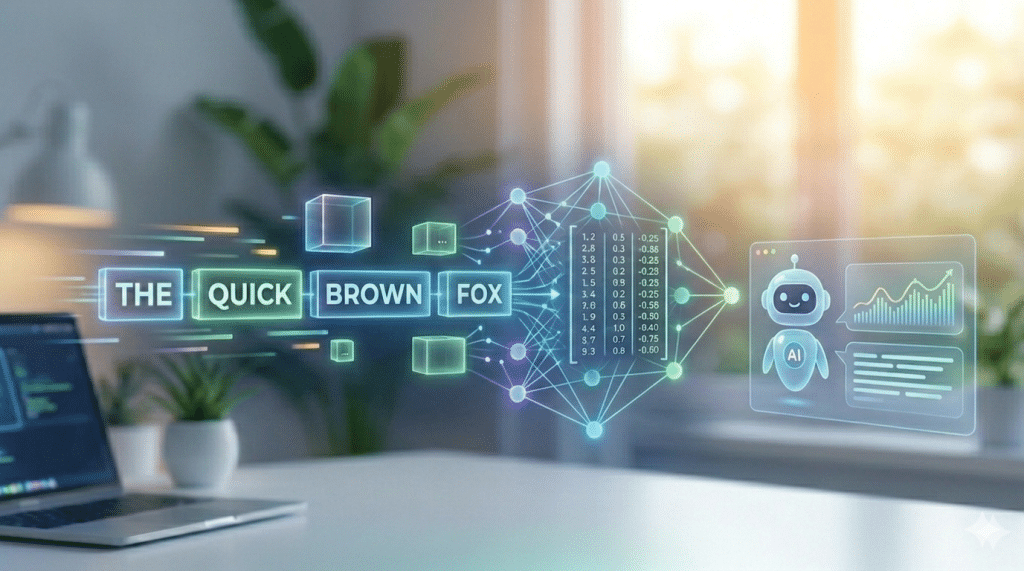
LLMs use tokens, which are chunks of text like words or groups of words. They map these tokens into vectors (called embeddings) that capture meaning and relationships between concepts. An embedding is like a mathematical representation of the meaning. This helps them understand context and stay coherent.
How A Generative AI Model like GPT4o Gets Built
Creating a generative AI model is a complex, resource-heavy process involving several major stages. Here’s how it works, step by step:
1. Data Collection
Models are trained on enormous amounts of text, code, images, and more. This data comes from:
- Public web pages (like Common Crawl)
- Books and academic papers
- Wikipedia and news articles
- Code repositories like GitHub
- Forums, dialogues, and transcripts
The goal is to give the model a broad, representative view of how language and media are used in the real world.
2. Data Cleaning and Preprocessing
Before training begins, the raw data is:
- Cleaned to remove spam, harmful or offensive content
- Deduplicated to avoid overfitting on repeated material
- Filtered for quality
- Tokenized into manageable pieces (words or subwords)
Each token is assigned an ID so it can be processed numerically.
3. Model Architecture Design
Developers choose an architecture—most commonly, a Transformer. Transformers use self-attention to understand relationships between words in a sentence, regardless of order.
Depending on the use case, the model may be:
- Decoder-only (for generating text)
- Encoder-only (for understanding input)
- Encoder-decoder (for tasks like translation)
4. Training the Model
This is the most resource-intensive step. The model is trained to predict the next token in a sequence. For example, given the prompt “The sun sets in the…”, the model learns to guess “west.”
This is done billions of times, updating internal weights (parameters) each time. This is where the model “learns” from examples.
Training can take weeks and involves:
- Thousands of GPUs or TPUs
- Petabytes of storage
- Millions of dollars in compute cost
5. Fine-Tuning and Instruction Training
After initial training, the model is refined with more specific data or tasks:
- Fine-tuning: Trains the model on a specialized dataset (e.g., legal documents)
- Instruction tuning: Teaches the model to follow directions more clearly using Q&A pairs and curated tasks
Some models also use:
- Reinforcement Learning from Human Feedback (RLHF): Human reviewers rate model outputs, guiding improvements
6. Testing and Evaluation
Developers test the model to evaluate:
- Accuracy and coherence
- Hallucination frequency
- Bias and safety risks
- Ability to follow instructions
If results fall short, teams may tweak data, retrain, or re-align the model.
7. Deployment and Updates
Once stable, the model is packaged and made accessible via API, app, or tool. But even post-launch, it may continue to evolve:
- Through updates and additional tuning
- By connecting to tools or data sources (RAG)
At each step, ethical oversight, testing, and quality control aim to make these systems not just powerful but also responsible.
What Happens When You Chat With an AI?

Talking to an AI might feel instant, but behind the scenes, it’s a rapid-fire process built on math, probability, and learned patterns. Here’s what happens:
Step-by-Step Breakdown
- Input is received: You enter a message like “What is a Transformer model?”
- System prompt is added: A hidden instruction sets the tone, e.g., “You are a helpful assistant.”
- Text is tokenized: The input is broken into small units (tokens) the model understands.
- Processing through layers: Each token is passed through dozens (or hundreds) of layers in the model.
- First token is generated: The model picks the most likely next token.
- Loop continues: That token becomes part of the input for predicting the next one.
- Response finishes: This continues until the model decides to stop (via stop tokens or length limit).
Temperature and Sampling
- Temperature controls randomness:
- Low (0.1–0.3): Predictable, factual answers
- Medium (0.5): Balanced tone
- High (0.8+): More creative, but riskier answers
- Sampling strategies decide how the next token is picked:
- Greedy: Always chooses the most probable token (can be repetitive)
- Top-k: Picks randomly from the top k tokens
- Top-p (nucleus sampling): Picks from the smallest group of tokens that together account for a set percentage of likelihood (e.g., 90%)
These settings affect the tone and variation of answers.
Why Answers Change
- The model doesn’t memorize responses; it generates them anew each time.
- Slight variations in context or randomness can lead to different outputs.
Guardrails and Moderation
- System prompts remind the model to stay on topic.
- Content filters scan for safety violations before or after generation.
- RLHF (Reinforcement Learning from Human Feedback) trains models to refuse unsafe requests.
Final Output
- The answer is streamed token-by-token so it feels like it’s typing in real-time.
- You receive a coherent, fluent response based on the model’s best guess of what should come next.
This whole cycle happens in seconds—but it’s the result of years of research and billions of training examples.
Key Concepts to Know (In Plain Language)
Understanding generative AI is easier when you’re familiar with a few foundational terms. Here’s what they mean:
Prompt engineering: The practice of designing your input text strategically to get better, more accurate responses from an AI. For example, asking “Summarize this email in two bullet points” tends to work better than a vague “Help with this.”
Tokens: AI doesn’t read whole words the way we do. It splits input into small units—tokens—that may be whole words, subwords, or even punctuation. For instance, “unbelievable” might become “un,” “believ,” and “able.” Most language models work token-by-token.
Embeddings: These are numeric representations of tokens. Embeddings allow the model to understand context and similarity. Words with similar meanings often have embeddings that are “close” together in mathematical space (like “king” and “queen”).
Context window: This is the model’s short-term memory. It limits how much text the AI can consider at once when generating a response. GPT-4 can handle thousands of tokens, but if your message and its response exceed that, it starts forgetting earlier content.
Fine-tuning: A secondary training phase where a general-purpose model is adapted to a specific task or dataset (e.g., legal or medical texts). This makes the AI more effective in narrow domains.
Instruction tuning: A training method where the model learns to better follow directions. It’s given examples of instructions and expected outputs, improving its responsiveness to natural language commands.
RAG (Retrieval-Augmented Generation): A hybrid technique that allows the AI to pull in external information (like a database or document) to answer questions more accurately. Instead of relying only on what it learned during training, the AI can “look things up” to stay current or more precise.
These concepts are the building blocks of how generative AI works. They explain why responses sound coherent, why tone varies, and how AI continues to improve.
What Generative AI Can (and Can’t) Do
Generative AI can:
- Write articles, poems, summaries, and code
- Generate realistic images or audio
- Translate and rephrase content
- Suggest ideas or complete tasks
Generative AI can’t:
- Think or understand like a human
- Know current events beyond its training
- Guarantee accuracy
- Avoid bias completely
It generates patterns, not truth. It’s powerful, but not magical.
Tools and Models You Should Know
The generative AI space includes many tools and models with distinct capabilities. Here’s a more detailed look at some of the most widely used and talked about systems:
GPT-4 (OpenAI)
- One of the most advanced large language models publicly available.
- Excels in writing, coding, summarizing, reasoning, and even interpreting images (in some versions).
- Powers ChatGPT and other enterprise tools like Microsoft Copilot in Word and Excel.
- Known for strong general-purpose performance, though limited by its context window (8K or 32K tokens).
Claude 2 (Anthropic)
- Focuses on being helpful, harmless, and honest.
- Handles long documents extremely well, with a 100K token context window.
- Ideal for reviewing large PDFs or complex conversations.
- Emphasizes ethical alignment through a method called “constitutional AI.”
PaLM and Gemini (Google)
- PaLM powers tools like Bard and AI features in Google Workspace.
- Gemini is Google DeepMind’s next-generation multimodal model, capable of handling text, images, and more.
- Gemini aims to combine Google-scale search knowledge with LLM flexibility.
LLaMA 2 (Meta)
- Open-weight models that researchers and developers can fine-tune.
- Comes in multiple sizes (7B, 13B, 70B parameters).
- Popular with the open-source community for running models locally or on private infrastructure.
- Forms the basis of community tools like Alpaca and Vicuna.
Midjourney / DALL·E / Stable Diffusion (Image Generation)
- Midjourney: Known for high-quality, artistic image outputs. Accessed through Discord.
- DALL·E: Built by OpenAI, integrated with ChatGPT. Good at interpreting textual descriptions into visuals.
- Stable Diffusion: Open-source and customizable. Widely used for commercial and personal creative projects.
GitHub Copilot / Code-Generating Models
- GitHub Copilot is a coding assistant based on OpenAI Codex.
- Suggests code as you type in VS Code and other editors.
- Accelerates software development and lowers barriers for beginners.
Other Tools
- ElevenLabs: Generates lifelike voiceovers.
- Synthesia: Creates AI-generated video avatars.
- Notion AI, Jasper, Writer.com: Offer writing assistants tailored to business or marketing tasks.
- RunwayML: AI-powered video editing and generation tools.
Choosing the Right Tool
The best model or tool depends on your needs:
- Writing and conversation? Try ChatGPT, Claude, or Gemini.
- Code generation? Copilot or Code Llama.
- Image creation? Midjourney or DALL·E.
- Open-source experimentation? LLaMA or Mistral-based models.
Some tools prioritize ease of use. Others are built for flexibility or performance. What matters most is how the tool fits into your workflow.
Frequently Asked Questions (FAQ)
How is generative AI different from ChatGPT?
ChatGPT is a generative AI tool based on an LLM. Generative AI includes many types: image, music, video, and code generators.
Can generative AI understand what it’s saying?
No. It recognizes patterns but lacks consciousness or comprehension.
Why does AI sometimes make things up?
It’s predicting text, not checking facts. So it might generate something that sounds right but isn’t.
Is it safe to use generative AI?
Generally yes, but outputs should be reviewed. It can make mistakes or show bias.
Can I run it on my own computer?
Yes—smaller models like LLaMA or Mistral can run locally if you have the hardware.
What’s the difference between fine-tuning and instruction tuning?
Fine-tuning adjusts the model to a specific dataset. Instruction tuning improves how it follows directions.
How much does it cost to train a model like GPT-4?
Tens or hundreds of millions of dollars. Training uses massive GPU clusters and weeks of time.
Can it be used for business?
Absolutely. It’s being used for content, support, analysis, design, and coding across industries.


Leave a Comment
You must be logged in to post a comment.