
Picture it: a sunny Saturday afternoon. You’re hauling your gas mower out of the garage, yanking the starter cord, and breathing in fumes, while your neighbor is sitting on the porch with a cold drink watching a little robot quietly trim his lawn by itself. No sweat, no noise, no effort.
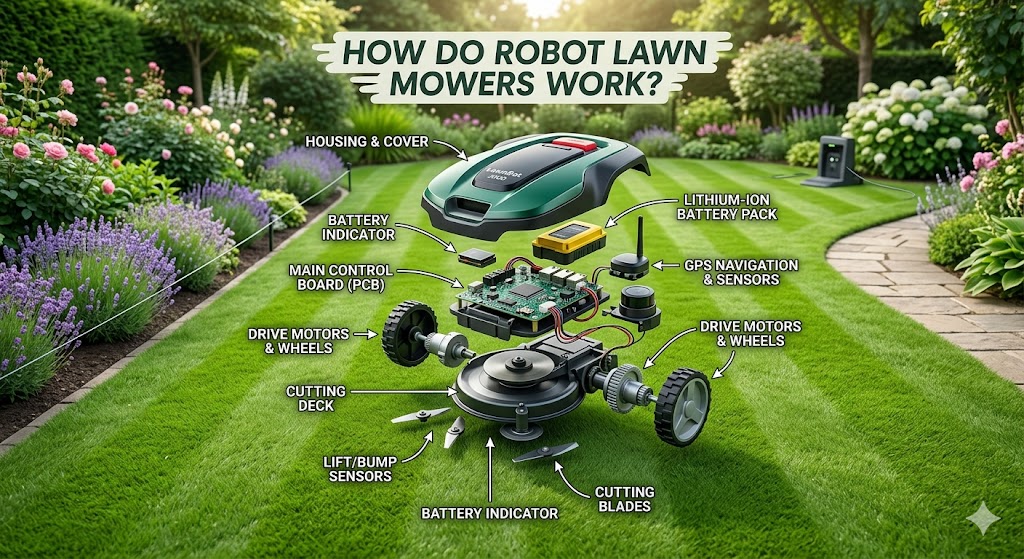
So how does a robot lawn mower actually work? It’s a fair question, because these machines look almost magical from the outside. The global robotic lawn mower market is already worth around $2.7 billion in 2026 and is on track to more than double over the next several years. A lot of homeowners are curious, but not many fully understand what’s going on under the hood. Let’s fix that.
What Is a Robot Lawn Mower, Really?
The easiest way to picture a robot lawn mower is to think of a Roomba, but for your grass. It’s a compact, fully electric machine that parks itself in a small charging station somewhere on your property. It heads out on a schedule you set, trims the lawn, and drives itself back home to recharge when the battery gets low.
Instead of one large spinning blade like your gas mower, a robot mower uses several small, razor-like blades mounted on a rotating disc underneath the body. It runs entirely on a rechargeable lithium-ion battery. No gas, no oil, no pull cord.
Most modern models connect to a smartphone app, so you can set mowing times, adjust cutting height, and check where the machine is, all from your couch. The first commercial robot mower appeared back in 1995, but today’s versions are in a completely different league thanks to GPS, cameras, and onboard sensors.
How Does It Know Where to Go?
This is usually the first thing people want to understand. A lawn is basically a big open field. How does the machine know where the grass ends and the flower bed begins? It comes down to which navigation system the mower uses, and there are two main approaches.
The Original Way: Boundary Wires
For most of the technology’s history, robot mowers relied on a thin boundary wire. You lay this wire around the outer edge of your lawn and around any obstacles you want the mower to avoid, such as trees, ponds, or garden beds. The wire connects back to the charging station and carries a low-frequency electrical signal.
Sensors on the underside of the mower detect that signal. When the robot gets close to the wire, it senses the boundary and turns back into the mowing zone. Think of it like an invisible fence for a dog, but for your lawn instead.
Boundary wires are reliable and don’t need internet or GPS to function. The downside is the setup. You either peg the wire above ground (where it can snag on rakes and feet) or bury it a few inches down. If the wire breaks, the mower gets confused until you find and patch the break. And if you ever want to change the mowing area, you have to physically move the wire.
The New Way: GPS, RTK, and Cameras
A fast-growing number of robot mowers have dropped the wire entirely. These machines navigate using satellite positioning, usually paired with a technology called Real-Time Kinematic, or RTK. Normal GPS puts you “somewhere in your yard.” RTK boosts that accuracy to within about two centimeters, roughly the width of your thumb.
Some models also carry LiDAR, which fires out laser pulses to build a 3D map of the terrain, or onboard cameras that spot obstacles like garden furniture, tree roots, or a stray soccer ball in real time. You set the mowing boundaries through an app by walking the perimeter with your phone, or by letting the mower map the space on its first run.
Here’s a quick comparison:
| Boundary Wire | Wire-Free (GPS/RTK/Camera) | |
|---|---|---|
| Setup | Wire installation required | App-based mapping only |
| Flexibility | Low (wire must be moved) | High (remap anytime) |
| Internet needed | No | Usually yes |
| Best for | Simple, stable lawns | Complex or large lawns |
| Reliability | Very high | High (with good sky view) |
Wire-free systems are more flexible, but they do need a clear view of the sky and a stable connection. If your yard is heavily wooded, a boundary-wire model may actually serve you better.
How Does It Actually Cut the Grass?
Here’s where robot mowers look very different from the machine in your garage. Instead of one big blade that hacks off several inches of grass in a single pass, a robot mower uses multiple tiny blades that spin at high speed and snip off just the very tip of each grass blade.
Because the mower runs so frequently (usually every day or every other day), it only removes a thin sliver of growth each time. Those miniature clippings are short enough to fall back into the turf and disappear into the soil. This is called mulching, and it’s genuinely good for your lawn. As the clippings break down, they release nitrogen and other nutrients back into the ground. You’re effectively fertilizing your grass every time the mower runs.
There’s no grass bag to empty, no clumps of wet clippings sitting on the lawn, and no risk of the “scalping” shock that can turn grass yellow after a heavy cut. Because the mower also changes direction randomly rather than following straight lines, you won’t see tire tracks or wear patterns pressed into your turf.
Power, Charging, and Handling Large Lawns
Robot mowers are completely battery-powered, almost always using lithium-ion cells. When the charge drops below a set threshold, the mower stops cutting, drives itself back to the charging dock, and plugs itself in. Once the battery is full, it heads right back out and picks up where it left off. That loop can repeat several times a day.
The cutting deck on most consumer models is between 8 and 14 inches wide, which is narrow compared to a ride-on mower. Covering a full acre might take many hours, or even multiple days of overlapping sessions. But the robot doesn’t care. It can run while you’re at work, while you’re asleep, or while you’re doing anything else with your Saturday.
Coverage varies considerably by model. Entry-level units are designed for a standard suburban lot, while premium machines can handle 1.5 acres or more on a single battery cycle. For very large or multi-zone properties, some manufacturers offer setups where several units coordinate with each other.
The charging station itself needs to sit on fairly flat ground, within reach of an outdoor power outlet, with clear space in front and to the sides. Many owners buy a small protective cover or garage to shield the station from heavy rain, harsh sun, and falling debris.
Safety Features and Obstacle Avoidance
Here’s a number worth knowing. According to data from the U.S. Consumer Product Safety Commission, an estimated 934,394 lawn mower injuries were treated in American emergency departments between 2005 and 2015, averaging around 85,000 injuries every year. Many of those are lacerations, fractures, and amputations from traditional gas-powered machines.
Robot mowers were built to take the human operator out of harm’s way, and they come with a solid set of safety features:
- Collision sensors. If the mower bumps into a pet, a child, or a forgotten garden gnome, it stops, backs up, and turns in a new direction.
- Lift and tilt sensors. If someone picks the mower up or it tips on a slope, the blades stop spinning instantly.
- PIN code protection. Most models require a PIN to operate. If a thief grabs the unit, an alarm sounds and the machine can’t be paired with a different charging station.
- Rain sensors. Many mowers detect wet conditions and pause their schedule. Wet grass is slippery, and soggy clippings can clog the undercarriage.
Noise is another genuine advantage. A typical robot mower runs at around 60 to 65 decibels, roughly the volume of a normal conversation. A standard gas push mower sits at around 95 to 100 decibels. You can run a robot mower early in the morning without waking the neighborhood.
Is a Robot Mower Right for a Large Lawn?
If your property is on the bigger side, you’re probably wondering whether one of these small machines can genuinely keep up. The honest answer is: usually yes, but there are a few real-world limitations you should know about first.
Contiguous lawns work best. Robot mowers like open, connected spaces. If your front yard and back yard are separated by a driveway, your house, or a thick hedge, a single unit can’t get from one to the other on its own. You’d either need to carry it between areas manually, set up a narrow wire corridor, or run separate mowers for each zone.
Slope limits are real. Most consumer-grade robot mowers handle inclines up to about 20 to 35 degrees. Premium models with all-wheel drive can push that to around 40 to 45 degrees. If you’ve got a yard that looks more like a hillside, a robot mower probably isn’t the right fit for those sections.
Edges still need a human touch. Because the mower’s body extends out past the blade disc, it can’t cut flush against a fence, retaining wall, or the foundation of your house. You’ll still need a string trimmer or edger for those spots.
Clean up before every run. Sticks, hoses, and kids’ toys need to be off the lawn before the mower heads out. And while a handful of high-end models now use AI cameras to detect and steer around dog poop, most will roll straight through it. Ask any robot mower owner and they’ll tell you the same thing: pick up after your pets.
Time works differently with a robot. Yes, a narrow cutting deck means covering an acre takes a long time. But because the mower runs on its own schedule while you get on with your day, that time doesn’t actually cost you anything.
FAQs
What are the disadvantages of a robotic mower?
The upfront cost is higher than a traditional gas mower, and the initial setup takes time, especially if you’re installing boundary wires. You’ll still need a trimmer for edges, and very steep slopes or disconnected lawn sections can be deal-breakers for a single unit.
Where does the grass go with a robotic lawn mower?
Nowhere that you’ll see. The mower mulches the clippings into tiny fragments that fall back into the lawn and decompose naturally, feeding the soil as they break down.
Do you need internet for a robot lawn mower?
Boundary-wire models generally don’t need internet at all. Wire-free GPS and camera-based models usually require a stable connection for mapping, app control, and software updates.
What is the lifespan of a robot lawn mower?
With regular maintenance, a quality robot mower can last 8 to 10 years or longer. Plan to replace the blades every few months and the battery every 2 to 4 years.
How do robot lawn mowers deal with dog poop?
Most models will roll right over it, just like a regular mower would. Some premium units with obstacle-avoidance cameras may detect and steer around it, but that’s not guaranteed. The most reliable solution is simply to clean up before the mower runs.
The Bottom Line
A robot lawn mower works by learning the boundaries of your yard (either through a buried wire or satellite-guided mapping), then quietly trimming a small amount of grass at a time using fast-spinning micro-blades. The clippings mulch back into the soil, the battery recharges automatically, and the whole cycle repeats on whatever schedule suits you.
It won’t suit every yard. Steep hills, separated lawn zones, and tight edges all have their limits. But if you have a large, reasonably open lawn and you’d rather spend your weekends doing something other than pushing a mower around, a robot mower is one of the few home gadgets that genuinely delivers on its promise.


Leave a Comment
You must be logged in to post a comment.