
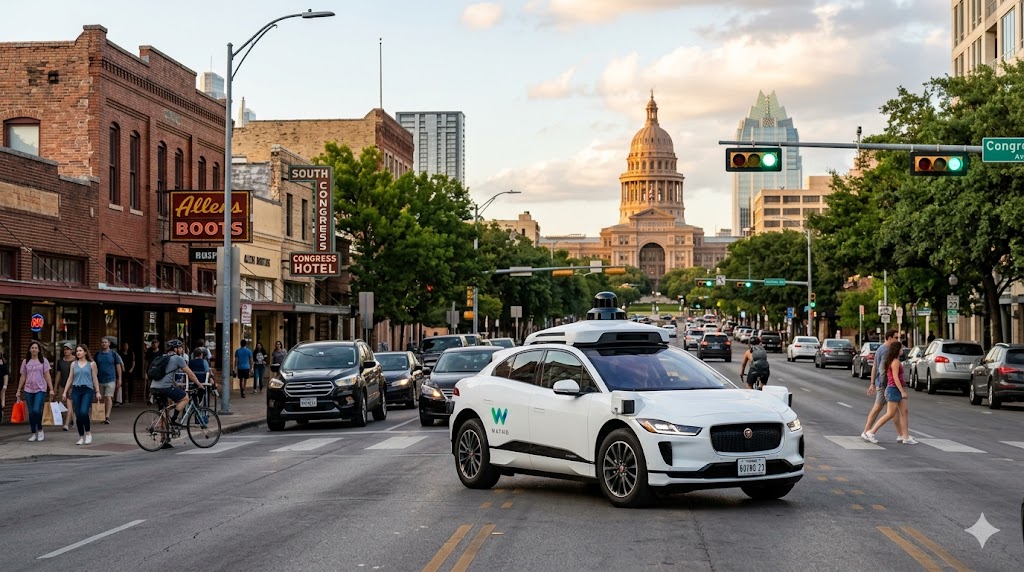
The robotaxi is no longer a concept from a science fiction film. Right now, you can open an app in Phoenix, San Francisco, Austin, or Wuhan, summon a fully driverless car, and ride across the city without a human behind the wheel. No driver. No safety attendant. Just sensors, software, and a surprisingly smooth commute.
That shift from experiment to everyday service has investors paying close attention. Goldman Sachs projects the global robotaxi market will reach approximately $415 billion by 2035, with the US portion alone hitting $48 billion — a figure the firm revised sharply upward from its prior $7 billion estimate, driven by faster-than-expected commercial deployments. The global fleet of commercial autonomous vehicles is forecast to grow from roughly 7,000 vehicles in 2024 to about 6 million by 2035.
The challenge for anyone trying to understand this market is that the media coverage skews heavily toward one or two companies. There’s a lot more happening than the Tesla headlines suggest.
This guide covers the full picture: what a robotaxi actually is, every major operator globally, where they’re running today, what rides cost, and what the regulatory environment looks like across the US, China, and Europe.
What you’ll learn in this guide:
- How robotaxi technology works (without the engineering jargon)
- Which companies are operating commercial fleets right now
- Where in the world you can actually take a robotaxi ride
- How pricing compares to Uber today and what it might look like in 2035
- The safety record, regulatory landscape, and legal questions that still need answers
What is a Robotaxi Exactly?
A robotaxi is a fully autonomous vehicle that provides on-demand ride-hailing services with no human driver involved at any point — from when you request the car to when you step out. You summon it through an app, the same way you’d call an Uber, but the vehicle navigates, stops, and handles traffic entirely on its own.
It helps to separate three concepts that often get blurred together:
- Self-driving car: A privately owned vehicle with autonomous driving features. Tesla’s Full Self-Driving (FSD) system falls here. A human is still responsible and expected to take control when needed.
- Ride-hailing: Platforms like Uber or Lyft that connect passengers with human drivers.
- Robotaxi: The combination of both. On-demand shared mobility, with no driver at all.
How Robotaxis Work: LiDAR, Cameras, Radar, and AI
The sensor stack is what makes autonomous operation possible, and most commercial robotaxis use several types simultaneously.
LiDAR (Light Detection and Ranging) fires laser pulses to build a real-time 3D map of the vehicle’s surroundings. Waymo’s vehicles, for example, use five LiDARs alongside six radars and 29 cameras. At Google I/O 2025, Waymo co-CEO Dmitri Dolgov demonstrated how the system detected a pedestrian in a Phoenix dust storm before any camera could see them — what he called “superhuman sensing ability.” LiDAR is expensive but reliable across lighting conditions.
Cameras handle computer vision tasks: reading traffic lights, identifying lane markings, recognizing signs, and tracking other road users. They’re cheap and high-resolution, but struggle in heavy rain, fog, or direct sunlight without LiDAR backup.
Radar detects objects and measures their speed in almost any weather. It’s the most weather-tolerant of the three but delivers lower resolution than LiDAR or cameras.
AI and HD maps tie it all together. Neural networks process the fused sensor data in real time, while centimeter-level pre-mapped road data gives the system a detailed baseline for every route.
Level 4 and Level 5 Autonomy: Why They Matter
The SAE autonomy scale runs from Level 0 (no automation) to Level 5 (full automation everywhere). The distinction that matters most for robotaxis is between Level 4 and Level 5.
Level 4 means the vehicle handles all driving tasks without human intervention, but only within defined conditions — typically a geo-fenced geographic area or specific weather parameters. Every commercial robotaxi operating today is Level 4.
Level 5 means the car can drive anywhere, anytime, in any conditions, without any design constraints. No commercial Level 5 vehicle exists today.
This distinction matters for investors: every current robotaxi service has a geographic ceiling. Expanding to a new city requires new mapping, new permits, and new testing. Scale is achievable, but it isn’t free.
Robotaxi Market Size and Growth
The financial opportunity in this space has grown substantially in the last two years — partly because deployments are accelerating, and partly because analysts are revising their models to reflect how fast costs are falling.
According to Goldman Sachs Research (April 2026), the global robotaxi market is projected to reach roughly $415 billion by 2035, with the US market specifically reaching $19 billion by 2030 and $48 billion by 2035. For vertically integrated operators — companies that both build and operate their own fleets — gross margins could range from 30% to 50%.
Fortune Business Insights estimates the global market at $0.61 billion in 2025, growing to $96.31 billion by 2034 at a 71.9% compound annual growth rate. North America held a 54.09% market share in 2025. Grand View Research puts the 2033 figure even higher at $147.25 billion, with a 99.1% CAGR from 2026.
The spread between forecasters is wide, but the direction of travel is unanimous: rapid, sustained growth.
Key Growth Drivers
Several structural forces are pushing the market forward faster than most expected.
Urbanization and mobility demand. More people living in dense cities creates consistent demand for point-to-point transport without the overhead of car ownership. Robotaxis fit this need precisely.
Falling sensor and compute costs. LiDAR units that cost $75,000 a decade ago now cost under $500. The economics of deploying a full sensor suite per vehicle are becoming viable at fleet scale.
Electrification and EVs. Every major commercial robotaxi runs on an electric platform. EVs have lower fuel and maintenance costs than combustion vehicles, which helps the unit economics significantly. They also satisfy the emission regulations increasingly being imposed in cities across the US, Europe, and China.
Government support. Arizona, Texas, and California have issued commercial robotaxi permits. China has built whole “smart city” corridors specifically designed for autonomous vehicle testing and deployment. The UAE has created permissive regulatory frameworks to attract AV companies.
The Challenges Holding the Market Back
It would be incomplete not to address the headwinds honestly.
Regulation is fragmented. In the US, federal safety standards set the floor but states regulate operations. What Waymo can do in Phoenix under Arizona law isn’t automatically replicable in New York. There’s no unified federal framework.
Public trust takes time. A single high-profile incident can reshape public perception for months. Cruise’s 2023 suspension after a pedestrian was dragged — covered extensively in national media — set back adoption discussions across the industry.
Unit economics are still being proven. Remote human oversight is still required per vehicle at various ratios. As that ratio improves (Goldman Sachs models it improving from 6:1 to 26:1 by 2035), the per-ride cost falls dramatically, but that scale hasn’t been reached yet.
Global Robotaxi Companies
Ten-plus robotaxi companies are operating or developing commercial robotaxi services across the US, China, Europe, and the Middle East. Here’s who they are, where they operate, and what makes each one distinct.
Waymo (Alphabet) — The US Market Leader
Waymo is the oldest commercial robotaxi operator in the United States, a subsidiary of Alphabet (Google’s parent company), and the company that has logged more fully driverless public miles than anyone else.
Its service, Waymo One, operates in Phoenix, San Francisco, Austin, Los Angeles, and Dallas. The fleet stands at roughly 2,500 Jaguar I-PACE autonomous vehicles, making it the largest commercial robotaxi deployment in the world. In June 2024, Waymo removed its San Francisco waitlist entirely, opening the service to all residents 24/7 with no prior registration required.
The sensor stack (five LiDARs, six radars, 29 cameras) gives Waymo an edge in edge cases — the unusual, unexpected situations that catch simpler systems off guard. Its safety record, while imperfect, outperforms human drivers on injury-causing crashes per mile in the cities where it operates.
Waymo’s differentiator is time. It’s been building commercial experience since 2020 and has the most real-world autonomous miles of any operator.
Baidu (Apollo Go) — China’s Dominant Pioneer

If Waymo owns the US, Baidu’s Apollo Go service is the dominant force in China.
Baidu operates fully driverless robotaxi fleets in Wuhan, Beijing, Shenzhen, and Shanghai, backed by China’s national push for smart cities and autonomous mobility. The Apollo platform is also an open-source framework adopted by other Chinese automakers, which means Baidu’s influence on the sector extends well beyond its own vehicles.
The government support Baidu receives isn’t just financial — it’s operational. China has built dedicated AV testing corridors, streamlined permitting in key cities, and invested in the connected road infrastructure that makes autonomous operations more reliable.
Baidu’s differentiator is scale within the world’s most populous country, operating in urban density that challenges Western AV systems regularly.
Tesla — The Vision-Only Disruptor

Tesla’s approach to robotaxi is fundamentally different from everyone else on this list. It rejects LiDAR entirely, relying solely on cameras and its neural network-based Full Self-Driving system. Critics say cameras alone can’t match LiDAR’s reliability in edge cases. Tesla argues that cameras are what humans use, so a sufficiently capable AI trained on enough real-world data should be able to do the same job.
Tesla plans to launch the Cybercab — a purpose-built robotaxi with no steering wheel and no pedals — with production targeted for 2026. Early robotaxi access programs launched in Austin and Dallas in 2025, using existing Tesla vehicles operating under FSD supervised mode.
Tesla’s structural advantage is its existing fleet: millions of vehicles on public roads every day, each collecting driving data that feeds back into FSD training. No other robotaxi company has anything close to that data flywheel. The Cybercab, if it reaches production on schedule, would be the first purpose-built robotaxi to enter mass production.
Pony.ai — The Cross-Border Operator

Founded in 2016 by former Baidu and Google engineers, Pony.ai is one of the few robotaxi companies running active operations in both the US and China simultaneously.
In the US, Pony.ai tests in Fremont and Irvine, California, with Toyota-backed autonomous vehicles. In China, it runs commercial robotaxi services in Beijing and Guangzhou, and separately operates PonyFreight, an autonomous trucking division. Toyota has invested significantly in the company, signaling that one of the world’s largest automakers sees Pony.ai as its autonomous vehicle strategy in China.
Its cross-market presence gives Pony.ai a data and regulatory advantage that single-market operators don’t have — it’s building expertise in two very different driving environments simultaneously.
WeRide — Expanding Globally from China

WeRide launched in 2017 in Guangzhou and has spent the years since building one of the more internationally ambitious autonomy programs.
Its China operations cover Guangzhou as the core, with partnerships across additional cities. More notably, WeRide has moved aggressively into the Middle East — running robobus and robotaxi pilot programs in Abu Dhabi and Dubai, where the regulatory environment is deliberately structured to attract AV companies. European testing programs are also underway.
WeRide’s investor base includes Renault-Nissan-Mitsubishi Alliance, Bosch, and GAC Group, giving it both manufacturing access and international distribution networks. Its multi-product approach — taxis, buses, and delivery — also provides more paths to profitability than a pure robotaxi play.
Zoox (Amazon) — The Purpose-Built Pod

Acquired by Amazon for over $1 billion in 2020, Zoox is building something genuinely different from every other company on this list.
Most robotaxis are existing car models retrofitted with autonomous hardware — a Jaguar I-PACE (Waymo), a Chevrolet Bolt (Cruise), or a Toyota Sienna (Waymo’s minivan model). Zoox is designing a vehicle from scratch, specifically for robotaxi service. The result is a bi-directional pod with no steering wheel, no driver’s seat, and forward-facing passenger seats on both ends. It can travel in either direction, which eliminates the need to turn around at the end of a trip and increases urban efficiency.
Zoox is currently testing in Las Vegas and San Francisco. Amazon’s backing provides nearly unlimited capital and a potential integration with logistics networks that could extend the business model beyond passenger trips.
Xpeng — The EV Maker Betting on Autonomy

Xpeng is one of China’s major EV manufacturers, known for building its own chips and autonomous driving software in-house rather than licensing from suppliers. Its XNGP (Navigation Guided Pilot) system handles highway driving, urban navigation, and parking across China’s major cities.
The company has announced plans to launch a dedicated robotaxi service and is developing purpose-built vehicles for that purpose. The strategy mirrors Tesla’s model: start with consumer EVs that generate revenue and training data, then transition to a robotaxi service once the autonomy stack is mature enough.
Xpeng’s advantage is its existing customer base and manufacturing infrastructure. Its disadvantage is that it’s entering the robotaxi market later than Baidu and Pony.ai, with more proving still to do.
CaoCao Mobility (Geely) — The Fleet Operator Pivoting to AV

CaoCao started as a ride-hailing platform backed by Geely, one of China’s largest automakers and the parent company of Volvo, Zeekr, and Lynk & Co. As the platform matures, CaoCao has shifted focus toward autonomous operations, running robotaxi fleets in Hangzhou using Geely’s vehicle supply chain.
Its structural advantage is the combination of an existing ride-hailing network (passengers, routes, and usage patterns already understood) and a parent company that can supply vehicles and manufacturing scale. Think of it as Geely’s answer to what Uber would look like if it built and operated its own driverless fleet.
AutoX — The Shenzhen Specialist

AutoX has focused its energy on proving autonomous capability in one of China’s most demanding urban environments: Shenzhen’s downtown core.
Founded in 2016 and backed by Alibaba and MediaTek, AutoX runs its Gen5 autonomous system through streets characterized by dense pedestrian traffic, complex intersections, and unpredictable conditions. The logic is that if the system can handle Shenzhen, it can handle almost anything.
Alibaba’s cloud and AI infrastructure supports the real-time data processing that dense urban autonomy requires.
Cruise (General Motors) — On Pause, But Not Out

Cruise was once considered Waymo’s most direct US competitor. GM-backed, with commercial services running in San Francisco, Austin, and Phoenix, Cruise was scaling quickly in 2022 and early 2023.
Then in October 2023, a Cruise vehicle dragged a pedestrian who had already been struck by another car, injuring her and failing to stop promptly. The incident led to a suspension of all Cruise operations, significant layoffs, and a restructuring of the division. GM has since kept Cruise in a limited R&D mode while evaluating a potential relaunch with a more conservative approach.
The Cruise story is worth including not as a failure narrative, but as an honest illustration of what goes wrong when safety culture, regulatory relationships, and incident response aren’t managed carefully. The underlying technology isn’t gone — and GM’s manufacturing capability means Cruise could return at scale if it earns its permits back.
Other Notable Robotaxi Players
The market extends beyond the names above. Motional (a joint venture between Hyundai and Aptiv) conducted robotaxi testing in Las Vegas before pausing consumer operations in 2023, though R&D continues. Yandex operates a robotaxi service in Moscow, one of the few examples of commercial autonomous mobility in Eastern Europe. EasyMile, a French company, focuses on autonomous shuttle routes rather than point-to-point taxis, with deployments across European airports and city transit systems. Didi Chuxing, China’s dominant ride-hailing platform, invested heavily in autonomous driving R&D before scaling back public-facing operations following regulatory scrutiny from Chinese authorities.
Where Robotaxis Operate Today: Global Deployment Map
Commercial robotaxi service is not as widespread as the news coverage might suggest. The geography is specific and still fairly concentrated, though it’s expanding.
View Global Robotaxi Deployments & Testing Hub Map on Google
United States
The US robotaxi market is functionally Waymo’s domain for now, with Tesla testing underway and others operating at smaller scale.
- Phoenix, AZ: Waymo’s original commercial market. Fully driverless, 24/7, no safety attendant. The most mature robotaxi deployment in the world.
- San Francisco, CA: Waymo opened fully to the public in June 2024. Zoox tests here as well.
- Austin, TX: Waymo operates commercially. Tesla launched its early robotaxi access program here in 2025.
- Dallas, TX: Waymo expanded here. Tesla is also testing robotaxi capabilities in the Dallas metro.
- Los Angeles, CA: Waymo launched service here in 2024, expanding its California footprint.
- Las Vegas, NV: Zoox’s primary testing market for its purpose-built pod.
- Fremont and Irvine, CA: Pony.ai testing locations under California AV permits.
China
China’s robotaxi deployment is broader and, in some cities, denser than the US.
- Wuhan: Baidu’s Apollo Go runs a large fully driverless fleet here, one of the most advanced deployments globally.
- Beijing: Both Baidu and Pony.ai operate commercial services, with multiple operators holding municipal permits.
- Shanghai: Baidu and other operators run active fleets.
- Shenzhen: AutoX’s primary city, focused on dense downtown conditions.
- Guangzhou: WeRide’s home base and most established operating city.
- Hangzhou: CaoCao Mobility’s core robotaxi market.
Middle East and Europe
The Middle East is becoming an important proving ground. Abu Dhabi and Dubai both have active WeRide programs, with local governments specifically marketing themselves as AV-friendly jurisdictions. Saudi Arabia has invited several Chinese operators for testing programs.
In Europe, commercial robotaxi service doesn’t yet exist at scale. EasyMile operates autonomous shuttle routes in several cities and airport facilities. Yandex runs service in Moscow. Germany, the UK, and Norway have limited testing zones but haven’t issued commercial robotaxi permits. The EU’s regulatory framework is more cautious than the US or China, creating higher barriers to entry.
Robotaxi Economics: What Does a Ride Cost?
The pricing question gets asked a lot, and the honest answer is: it depends on the market and the operator.
Robotaxi vs. Uber Today
Waymo One pricing in Phoenix and San Francisco is broadly competitive with UberX. In practice, fares are sometimes slightly cheaper, sometimes on par, depending on promotions and surge pricing on both platforms. Waymo doesn’t publish a fixed rate card, but riders consistently report fares in the same ballpark as standard ride-hailing.
In China, Baidu’s Apollo Go has used aggressive subsidy pricing to build adoption in Wuhan, with some rides offered at rates approaching free during promotional periods. This is a market-building strategy, not the sustainable economics model — but it reflects how seriously Chinese operators are pursuing market share.
Where Costs Are Headed
The long-term economics look genuinely attractive, because the single largest cost in traditional ride-hailing — the human driver — is eliminated entirely. That driver typically accounts for 60-70% of the cost of a ride.
Goldman Sachs Research projects that total cost per mile for a vertically integrated robotaxi operator could drop below $1 in the US by 2035. The key drivers are:
- Vehicle depreciation falling from roughly $0.35 per mile in 2025 to $0.14 per mile in 2035, as vehicle costs decline and utilization rates improve.
- Remote human oversight costs dropping as the ratio of vehicles supervised per human operator improves from 6:1 today to 26:1 by 2035.
- Insurance premiums declining as proven safety records reduce risk profiles.
A sub-$1 per mile cost structure would make robotaxis meaningfully cheaper than both human-driven ride-hailing and, in many cases, personal car ownership once depreciation and insurance are factored in.
Business Models: Who Owns the Fleet?
Three business models are emerging, and understanding them matters for investors.
OEM-owned fleets: The tech company designs, builds, and operates its own vehicles. Waymo, Baidu, Tesla, and Zoox all follow this model. The vertical integration creates the highest potential margins but also the highest capital requirements.
Platform-licensed fleets: An automaker provides the vehicles; the tech company provides the autonomy software. Think of how Waymo has considered licensing its driver to third-party manufacturers, or how Hyundai supplies vehicles to Motional.
Ride-hailing integration: Existing platforms like Uber integrate robotaxis into their networks. Uber already does this — Waymo vehicles are available through the Uber app in some markets. This model requires the least capital from the platform but captures the least margin.
Safety, Regulation, and the Legal Road Ahead
Safety is the central issue the robotaxi market can’t escape, and rightfully so.
Are Robotaxis Safe?
The early data is cautiously positive. Waymo’s published safety reports show fewer injury-causing crashes per mile than human drivers in the cities where it operates. Tesla’s FSD data from 2023 showed 3.2 million miles per accident on supervised FSD, compared to 588,000 miles for human-driven Teslas and roughly 192,000 miles for the US national average.
Cruise’s 2023 incident, where a vehicle dragged an injured pedestrian, is the counterweight. It’s a reminder that systems performing well 99.99% of the time can fail catastrophically in novel situations — and that the response to those failures shapes public trust as much as the underlying statistics.
The honest assessment: robotaxis are probably safer than the average human driver in the cities where they operate, but they’re not infallible, and incidents have a public visibility that human-caused accidents rarely do.
The Regulatory Landscape
United States: Regulation is fragmented by design. The federal government (specifically NHTSA) sets vehicle safety standards, but states govern actual operations. Arizona and Texas have built permissive regulatory environments that actively attract AV companies. California requires detailed permitting and ongoing reporting. New York and most states haven’t issued commercial robotaxi permits at all. Congress hasn’t passed a comprehensive federal AV framework, despite several attempts.
China: The approach is top-down and deliberately supportive. National and local governments have issued commercial licenses in Wuhan, Beijing, Shenzhen, and other cities. The government sees AV leadership as a strategic priority — economically and geopolitically — and has structured its regulatory environment accordingly. Speed of deployment in China reflects that alignment between industry and government.
European Union: The most cautious of the three. The EU AI Act, type-approval processes, and member-state differences create a multi-layered barrier. Most European AV activity remains confined to pilot zones and research programs. Commercial robotaxi services at scale are likely several years behind the US and China.
Liability: Who’s Responsible?
When there’s no driver, the question of fault in an accident shifts fundamentally. Currently, operating companies (Waymo, Baidu, etc.) carry commercial fleet insurance and assume liability for incidents involving their vehicles. That’s workable at today’s scale.
As fleets grow to tens of thousands of vehicles across multiple jurisdictions, the insurance models will evolve toward telematics-based commercial fleet policies, with premiums calibrated by safety data rather than driver history. The liability question isn’t resolved, but it’s being actively worked through in courts and regulatory agencies — and the direction is toward treating robotaxi operators like commercial carriers, not individual drivers.
The Future of Robotaxis
Timeline for Mass Rollout
The near-term picture is one of expansion within proven markets rather than sudden global ubiquity.
2025-2027: Existing operators add cities. Waymo likely adds more US metros. Baidu continues scaling in China. Tesla begins Cybercab production and early commercial operations if the 2026 target holds. The total commercial fleet globally grows from roughly 7,000 to tens of thousands of vehicles.
2028-2030: Cost per mile drops below human-driven ride-hailing in major US and Chinese cities. Multiple operators move toward profitability. Goldman Sachs projects the US market reaching $19 billion in this period. Uber and Lyft deepen their AV integrations to defend market position.
2030-2035: Widespread adoption in tier-one cities globally. The commercial fleet reaches millions of vehicles. Personal car ownership starts declining meaningfully in the densest urban markets as robotaxis offer a cheaper, more convenient alternative.
The Impact on Urban Mobility
The downstream effects extend well beyond a cheaper taxi fare.
Personal vehicles sit idle roughly 95% of the time. A robotaxi operating 20+ hours per day at high utilization can replace multiple private cars, cutting the total number of vehicles a city needs to move the same number of people. That frees up parking space in dense cities — meaningful square footage that cities could convert to housing, green space, or commercial use.
Human error causes over 90% of traffic accidents. A proven robotaxi system operating below the human accident rate, at scale, would deliver one of the most significant road safety improvements in decades.
Uber and Lyft both understand the risk. They’re investing in AV partnerships precisely because a world of cheap, driverless rides is a world where their value as a driver network disappears. The platforms that survive will be those that reposition themselves as autonomous fleet operators before the transition forces their hand.
For investors, the long-term case is clear. The near-term execution risk is real, but the companies that reach scale with safe, cost-efficient operations will own a substantial slice of what is currently a $400+ billion annual ride-hailing market.
Frequently Asked Questions About Robotaxis
What is a robotaxi and how does it work?
A robotaxi is a fully autonomous, driverless vehicle that provides on-demand ride-hailing services. You summon it through a smartphone app, just like Uber or Lyft. The vehicle uses LiDAR, cameras, radar, and AI to navigate without any human intervention from pickup to drop-off. All commercial robotaxis today operate at Level 4 autonomy, meaning they’re fully capable within specific geographic areas but haven’t been certified for unrestricted driving everywhere.
How much does a robotaxi cost compared to Uber?
Currently, Waymo pricing in Phoenix and San Francisco is broadly competitive with standard UberX fares. In China, Baidu’s Apollo Go has offered heavily subsidized rides during promotional periods to build adoption. Long term, Goldman Sachs projects the total cost per mile for robotaxi operators could drop below $1 in the US by 2035, as driver wages are eliminated and operating costs fall with scale. That would make robotaxis cheaper than human-driven ride-hailing and, potentially, cheaper than owning a car in a dense city.
Where are robotaxis available in the US?
As of 2025, commercial robotaxi services operate in Phoenix, San Francisco, Austin, Dallas, and Los Angeles (all Waymo). Tesla launched early robotaxi access programs in Austin and Dallas using its existing vehicle fleet. Zoox tests its purpose-built pod in Las Vegas and San Francisco. Pony.ai holds testing permits in Fremont and Irvine, California. Full commercial services don’t yet operate outside these markets.
Are robotaxis safe?
Early data is cautiously positive. Waymo’s published reports show fewer injury-causing crashes per mile than human drivers in its operating cities. Tesla’s 2023 FSD data reported 3.2 million miles per accident under supervised operation, compared to a US national average of around 192,000 miles per accident. All commercial operators carry insurance and assume liability for incidents. High-profile failures — like Cruise’s 2023 suspension — receive significant media attention, but the aggregate data across millions of miles is trending in the right direction.
Can police pull over a driverless car?
Yes. Law enforcement can stop an autonomous vehicle for traffic violations. Most commercial robotaxis have remote communication systems that allow company operators to speak with officers through the vehicle’s speakers. Waymo vehicles can also pull over when signaled by emergency lights and sirens. Some jurisdictions are developing formal protocols for interacting with driverless vehicles during traffic stops, but the practical mechanics are already in place.
Which companies make robotaxis?
The leading commercial operators are Waymo (US), Baidu Apollo Go (China), Pony.ai (US and China), WeRide (China and Middle East), Zoox (US), and AutoX (China). Tesla is developing the Cybercab for planned 2026 production. Xpeng and CaoCao Mobility are building toward commercial operations in China. Cruise, backed by GM, operated in the US before a 2023 suspension and is currently in a limited R&D phase. Motional, Yandex, and EasyMile are active in other markets.


Leave a Comment
You must be logged in to post a comment.