
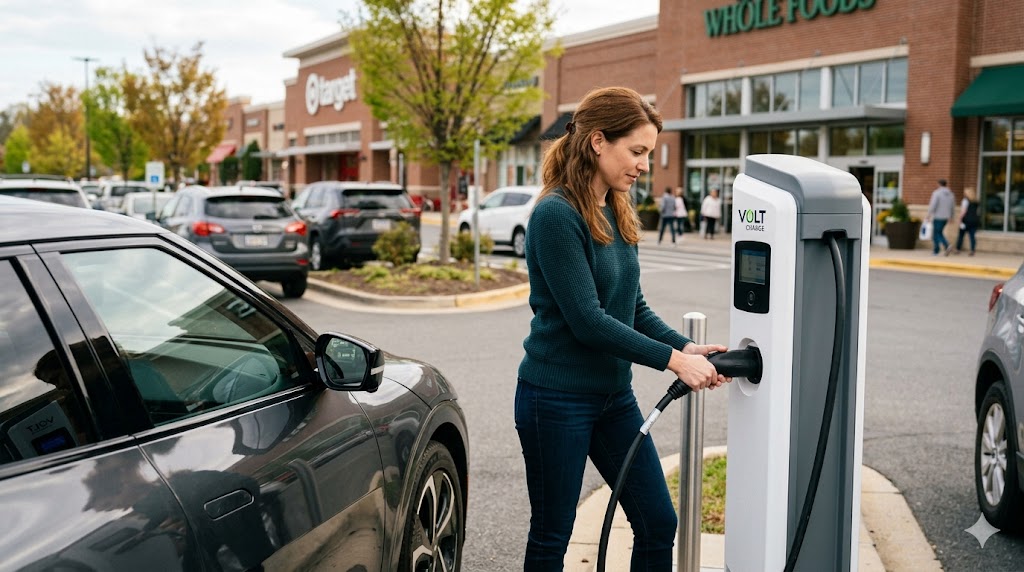
If you are thinking about buying your first electric car, you have probably asked this question a hundred times. The honest truth: it depends. Charging an EV can take anywhere from about 20 minutes at a highway fast charger to well over 24 hours on a regular wall outlet.
The good news? Today’s EVs charge much faster than models from just a few years ago. Once you understand three variables, you will never be confused again: the charger type, your battery size, and how fast your car can accept power.
EV Charge Time Calculator
Level 1, Level 2, and DC Fast Charging: What’s the Difference?
Every EV can charge using one of three methods.
Level 1: The Regular Wall Outlet (20+ Hours for a Full Charge)
Level 1 means plugging into a standard 120-volt household outlet. Every EV comes with a cable for this. You will add about 3 to 5 miles of range per hour. Filling an empty battery could take two full days.
For many drivers, Level 1 is enough. The average American drives about 40 miles daily. If you plug in every night, you will wake up with those miles back. But most EV owners eventually upgrade.
Level 2: Home and Workplace Charging (4 to 10 Hours for a Full Charge)
Level 2 uses a 240-volt outlet. Most EV owners install one at home. These deliver 7 kW to 11 kW, adding about 25 to 35 miles of range per hour. A typical 60 kWh battery fills in roughly 6 to 8 hours while you sleep. Workplace chargers are usually Level 2 too, which makes “top-up charging” easy.
DC Fast Charging: The Highway Stop (20 to 45 Minutes to 80%)
DC fast chargers pump direct current straight into your battery, bypassing your car’s onboard converter. They range from 50 kW to over 350 kW. Most manufacturers quote “10% to 80% in 30 minutes.” Why 80%? Because charging slows dramatically after that to protect battery health. That last 20% can take as long as the first 80%. The main US networks are Tesla Superchargers, Electrify America, and EVgo.
| Charger Type | Power | Typical Full Charge | Miles Added Per Hour | Best For |
|---|---|---|---|---|
| Level 1 | 1.2 kW | 20 to 40+ hours | 3 to 5 miles | Emergencies |
| Level 2 | 7 to 19 kW | 4 to 10 hours | 25 to 75 miles | Daily home charging |
| DC Fast | 50 to 350+ kW | 20 to 45 min (to 80%) | 10 to 20 miles per minute | Road trips |
Real-World Charging Times for Popular 2026 EVs
Here is what charging looks like for popular 2026 models on a DC fast charger.
The Hyundai Ioniq 6 goes from 10% to 80% in about 18 minutes. The Porsche Taycan and Kia EV6 hit roughly the same mark. These three share an 800-volt architecture. Tesla’s Model 3 and Model Y take about 25 to 30 minutes. The Chevrolet Silverado EV, with its massive 200+ kWh battery, needs over an hour for a full fast charge.
Why “10 to 80%” Is the Real Metric
Nobody charges from zero to 100%. You rarely arrive at a charger completely empty, and charging speed is highest when the battery is low. The middle 60%, from 20% to 80%, is the fastest zone. For daily driving, that is all you need.
Five Factors That Actually Affect Your Charging Time
Battery Size
A larger battery stores more energy but takes longer to fill. The GMC Hummer EV has a 205 kWh pack. Even though it accepts high charging power, it takes significantly longer than a Lucid Air with a 112 kWh pack.
Your Car’s Onboard Charger
The converter inside your car has its own speed limit. A vehicle with an 11.5 kW onboard charger will charge nearly twice as fast on Level 2 as one with a 6.6 kW unit.
The Last 20% Slowdown
Charging slows dramatically past 80% to protect battery health. On a DC fast charger, going from 80% to 100% can take as long as going from 10% to 80%.
Weather
Batteries prefer moderate temperatures. In extreme cold, your car may spend several minutes warming the battery before accepting high-speed charging. According to Recurrent’s 2026 winter study, EVs retain an average of 78% of their normal range at 32 degrees Fahrenheit.
Charger Power vs. What Your Car Can Accept
A 350 kW charger cannot charge a Nissan Leaf faster than the Leaf’s 150 kW limit. Actual speed is always the lower of: what the charger delivers, and what your car accepts.
How Fast Is Fast Charging in 2026?
If you have not looked at EV charging speeds since 2020, you are in for a surprise.
Average Charge Acceptance Rate Hit 165 kW
In 2020, the average EV could accept about 60 kW at a DC fast charger. By 2026, that number has climbed to 165 kW, according to data from Incorrys.
Fastest EVs Can Add 100 Miles in Under 10 Minutes
A better metric than peak kW is “time to add 100 miles.” According to Recurrent’s 2026 analysis, the quickest EVs can do this in under 10 minutes. The Hyundai Ioniq 5 leads at about 5.8 minutes in ideal conditions. The Porsche Taycan and Lucid Air follow closely.
Tesla’s Average Supercharging Session Is Now Under 30 Minutes
Tesla publishes data on average Supercharging session times. In mid-2018, the average was about 35 minutes. By summer 2024, it had dropped to around 27 minutes. The trend is heading toward roughly 25 minutes per session.
The BYD Breakthrough: 5 Minutes to 70%
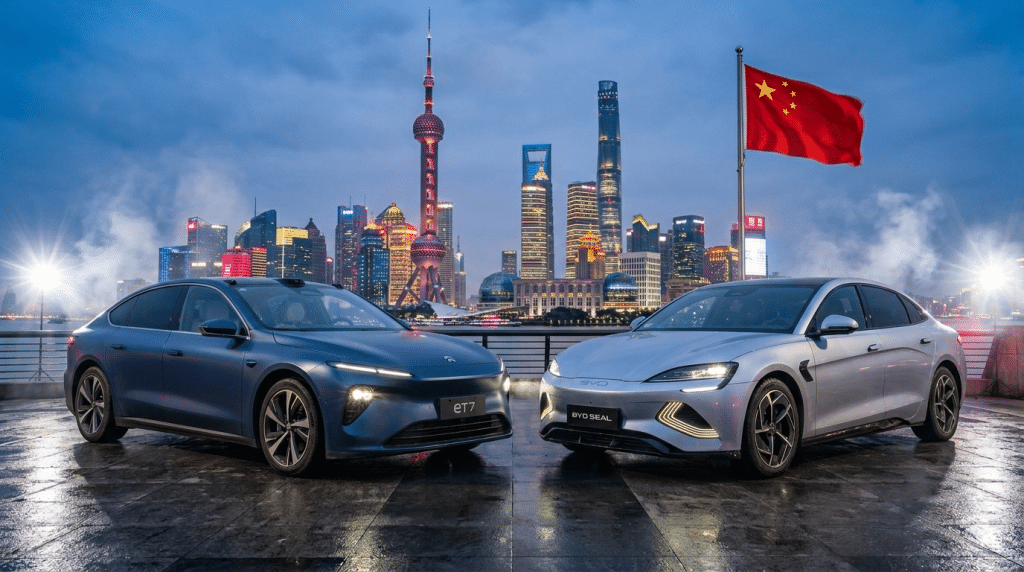
In March 2026, BYD unveiled its second-generation Blade Battery and FLASH Charging system, capable of delivering up to 1,500 kW. It recharges a compatible vehicle from 10% to 70% in about 5 minutes. This technology is rolling out in China and Europe, signaling where the industry is heading.
Charging Time vs. Cost: What You Actually Pay
Home charging on a Level 2 unit is cheap. Most Americans pay between $0.12 and $0.16 per kilowatt-hour. Filling a typical 60 kWh battery at home costs roughly $7 to $10.
Public DC fast charging is more expensive. According to Paren’s Q1 2026 industry report, average US fast charging prices held steady at about $0.53 per kilowatt-hour. That same fill costs $30 or more on the road. Most drivers do 80 to 90% of charging at home, where it is slow but cheap. Fast charging is for road trips.
Three Smart Charging Habits Every New EV Owner Should Know
The 80/20 Rule
For daily driving, keep your battery between 20% and 80%. This reduces stress on the cells. Recurrent’s data shows the average EV retains 97% of its original range after 3 years.
Top-Up Charging
Your car sits parked about 95% of the time. Use that time. Plug in at home, at work, or while you are at the gym. Think of your EV like your phone: you top it up during the day rather than running it to zero.
Preconditioning Before Fast Charging
Many modern EVs can pre-heat their battery when you navigate to a fast charger. A warm battery accepts power faster. Use your car’s native navigation to route to chargers so the vehicle knows to prepare itself.
EV FAQs
How long does it take to charge an electric car at home?
A typical 60 kWh EV on a 7.4 kW Level 2 home charger takes just under 8 hours for a full charge from empty. Most owners plug in overnight and wake up to a full battery every morning.
Is 20 minutes enough to charge at a public station?
On a 150+ kW DC fast charger, 20 minutes can add roughly 100 to 150 miles of range to a modern 2026 EV. For most road-trip stops, that is plenty.
Can I charge my EV to 100% every night?
You can, but you do not need to. Most manufacturers recommend keeping daily charging between 20% and 80%. Charge to 100% only when you need maximum range for a long trip.
What happens if I don’t drive my electric car for months?
EV batteries gradually self-discharge when idle. For long-term parking, leave the battery at around 50% and keep it plugged in with a charge limit set if possible.
How long does charging take in winter?
Cold weather slows charging and reduces range. According to Recurrent’s 2026 winter study, EVs retain an average of 78% of their range at 32 degrees Fahrenheit. Charging times at DC fast chargers can increase by 20 to 40% in freezing conditions.
Final Thoughts
So, how long does it really take to charge an electric car? Anywhere from 20 minutes to 24 hours, depending on what you are using. But for most EV owners in 2026, the real answer is: you plug in at night, you sleep, and you wake up to a full tank. For road trips, a 25 to 30 minute stop every couple hundred miles is the norm, and it is getting shorter every year.
Average fast charging speeds have nearly tripled since 2020. Some 2026 models add 100 miles in under 10 minutes. And with BYD now demonstrating 5-minute charging to 70%, the gap between refueling a gas car and recharging an EV is closing faster than most people realize. The inconvenience is already smaller than you think, and it is shrinking every year.

Leave a Comment
You must be logged in to post a comment.